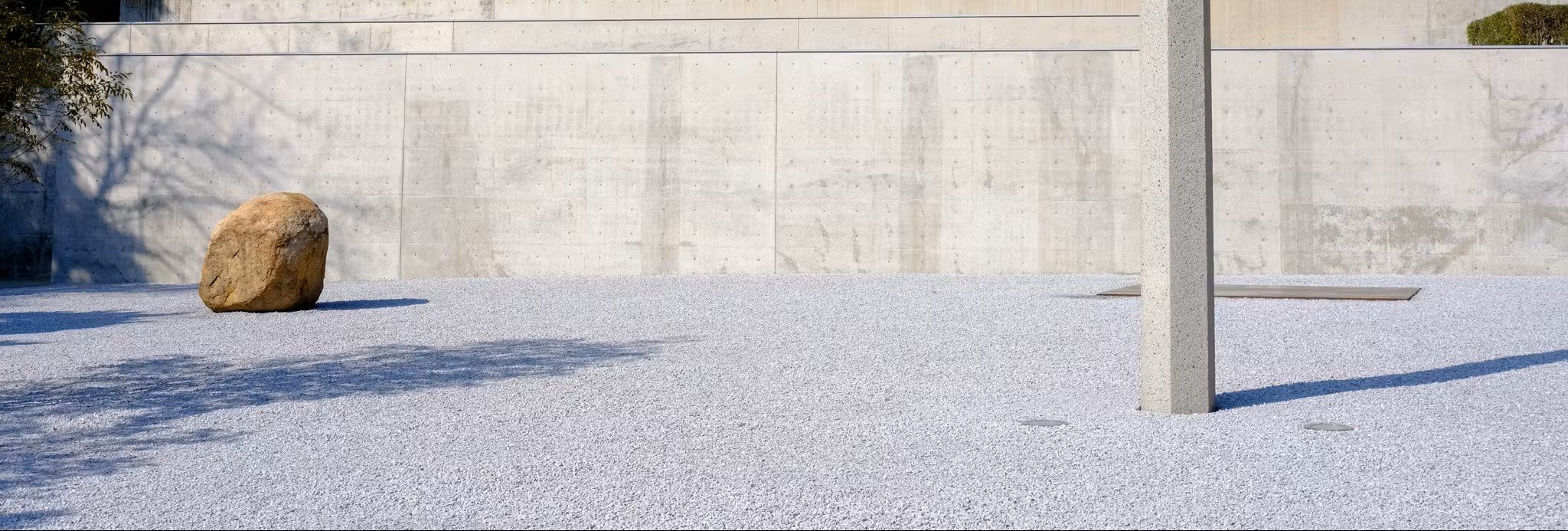
The Artist
An article in the Guardian on Monday 4 May 2026, Walk this way, Alex Needham asked whether the island of Naoshima, known as Japan’s “art island”, is the ultimate location for visual transcendental, contemplative art and experience. It is “studded with dim, concrete-walled galleries sunk into hillsides, designed by architect Tadao Ando. They have a contemplative, almost worshipful ambience and are filled with extraordinary paintings, sculptures and installations. The article focuses one artist, Korea-born Lee Ufan, celebrating his ninetieth birthday next month.
Needham says Lee looks nowhere near his great age. When asked for the secret of his youthfulness Lee says “I call myself a nomad – I travel a lot, visiting many other places and meeting many people. I still don’t understand the world and I want to know more. That probably gives me energy to stay young.”
He does breath exercises every day:
“I always have 10 to 15 minutes of tuning my breath, then trying to achieve quietness, to calm down my body. In a way, I think I’m using silence as a medium. I always talk about connecting to nature and through that, connecting to art. But then I am, in a way, self-centred, so there’s an irony in that.”
Needham says Lee’s sculptures – boulders carefully placed on the ground; a large concrete pole displayed on a bed of pebbles –serve as conduits to deeper contemplation. Lee says his work expresses something about the relationships between the interior and the exterior, the awareness of our bodies in nature, and of finding our essential selves amid so much noise.
“My work always bridges to something. Being open to connecting with others is so important.”
The Field
I first met Jeremy Timm, a contemplative friend and past trustee of Changing Attitude, at the 2008 Lambeth Conference. He recently invited me to stay with him at Corner Cottage on the banks of the river Ouse in Yorkshire. Jeremy once trained for the priesthood, was an evangelical missionary, kept horses, and was a flour miller. For the past fourteen years, having closed his stables, he has been creating in the field at the rear of the house, a contemplative wooded environment with trees, an impressive standing stone and mystical works of art. He follows his intuition, allied with a deep love for and commitment to the beauty and mystery of trees.
Jeremy’s field is a companion to the island of Maoshima, a visual, experiential, transcendent, contemplative space that serves, like Lee’s sculptures, as a conduit to deeper contemplation. Jeremy was never ordained but became a Reader. He gradually became disenchanted with the Church of England’s failure to respect the ministry of LGBTQIA+ people and affirm equal marriage. He is a member Contemplative Fire https://contemplativefire.org/, “an exploration of a great spiritual tradition as it impacts life in the 21st century; a path of unknowing and knowing, of being loved and loving, of letting go and taking hold. ”Individual seekers, members of Contemplative Fire and other groups and people seeking spiritual direction, are gradually becoming aware of Jeremy’s field and visit for conversation, time alone in the field, drumming, meditative walks, Zen sits.
The Zen Teacher
Jeremy recently introduced me to Christopher Collingwood, an Anglican priest, retired– Canon Chancellor of York Minster, a Zen teacher and member of the Wild Goose Sanga that counts a number of other Anglican priests among its members. You can listen to Christopher being interviewed about his integration of Christian and Zen traditions and practices in Zen Wisdom for Christians, a Nomad podcast.
The Island of Naoshima, Jeremy Timm’s field and Christopher Collingwaood’s Wild Goose Zen Sanga are manifestations of the dimensions of my spiritual life that have enriched my health and sanity and brought coherence to my theology and campaign zeal. I believe the transcendental, contemplative, sacred, experiential dimensions of life are an essential element of healthy, creative human societies and religious belief and practice.
I identify myself as a contemplative activist. Since I retired eleven years ago, I’ve been collecting articles about varieties of spiritual wisdom and practice and others that describe the decadence and decay into which we are now living.
The decadent, abusive, unhinged, unhealthy dimensions of life
In another article in the same Guardian, Monday 4 May 2026, Look beyond the pomp: here are the last rites for a dying era, Nesrine Malik writes about the ‘last rites events’ that characterise the era we now live in. She names Trump’s USA and the colossal violations of democratic norms; the war on Iran; the global energy and climate crisis; the vulgar signs of an American regime at the peak of excess; the whole world teetering on the edge of a precipice, the way in which US State Policy is now communicated, policies which affect whether billions of people will still sleep safely and be able to afford basic foods. One of the most jarring things about the crisis we are living in, she says, is how lives carry on much as normal, even as Trump engages in all manner of unhinged behaviour or threatens to wipe out an entire civilisation.
I read the Guardian, listen to the BBC radio 4 news, watch Channel 4 News, not because I’m a masochist but because I want to know what insane Truth Social or mid-air comment or throw away remark Trump has made that financial markets will react to, making millions for some, and disturbing my personal emotional equilibrium. What comes next, asks Malik? The trajectory is towards “more trouble, rather than tranquillity: the possibility of an extended war on Iran and further Middle East destabilisation, global energy shocks, perhaps even the unravelling of Nato and the breakdown of US democracy itself.”
The decadent, abusive, unhinged, unhealthy dimensions of Christianity
The decadence I witness isn’t exclusive to the secular realms of society. The decline into decadence also affects and infects the Church. It’s less easy to identify and name here in the Church of England. It’s been very visible in the high-profile cases of abuse that have been reported in recent years; the cases of Bishop Peter Ball, John Smyth, Chris Brain and Soul Survivor and many others. It’s visible now in the repeated failures of the Church of England National Safeguarding Team to respond to survivors and accelerate safeguarding reforms.
Why is the Church of England so unaware of its own decadence?
The C of E is in a very unhealthy state. Numerous conversations with friends and encounters in churches I visit demonstrate the crisis affecting the Church. It has not developed a corporate awareness or alertness to the dangers inherent in adopting models simply because they ‘grow’ congregations, thus helping them to survive and become financially independent. Smaller congregations, following more Christ-like models, are left to swim – or sink – and many good people and priests and congregations are sinking.
The Church of England, her bishops, members of General Synod, new congregation members, do not have the inner mechanisms required to identify what is so decadent and unhealthy in what passes for its Christian teaching and practice. The Trumpian far right conservative evangelical charismatic culture and practice is infecting everything and everyone, including C of E bishops, clergy and congregations. Churches are forced to adopt new patterns of worship. With the new worship patterns come new, reactionary theologies and teachings. People are encouraged to be inclusive and generous, giving themselves emotionally to God, open their hearts to the power of the Holy Spirit, trusting the feelings evoked by singing choruses.
The Decline of Wisdom
One outcome of the way the Church is being infected by an unhealthy culture is the decline of religious and Christian spiritual wisdom and awareness, depth and practice. The ways in which in the past contemplative communities and individuals, dedicated to stillness, silence, reflection, deep presence, wisdom, interior awareness, grounded and influenced congregations and leaders has almost disappeared.
If the Church is to recover a healthy essence in faith and life, then it needs to develop personal trust in and awareness of our presence in the depth of life; an awareness of the divine, holy, sacred energy essence named God by Christians, manifest in Jesus, seamlessly present in all creation and in every human being. I think it’s vital for the Church to develop a framework, awareness, consciousness, of practice and teaching and training about healthy and unhealthy patterns of faith, belief, theology, spiritual practice and language. In my conversations with bishops and other active leaders I find a void. People are unaware, unconscious of the unhealthy environment they inhabit.
How to find our way out of the wilderness of confusion and abuse
Salvation comes from the Guardian, in the content of an article published on Saturday 02 May 2026, We need to bring wisdom back into the world, Sophie McBain writes about Emmy van Deurzen, author of The Art of Existential Freedom. Van Deurzen, born in Holland, moved to the UK in 1977 having studied philosophy and psychology. She was inspired by R D Laing, Viktor Frankl, the poet Rumi, Rollo May, Paul Tillich’s The Courage to Be (1952) and Erich Fromm’s The Art of Loving (1956). She is interested in how we can cultivate meaning, courage and freedom despite the suffering life throws at us, a process that begins with how we approach life and how we cultivate our inner worlds.
Addressing the mental health crisis in the UK today, she believes “we have focused so much on materialistic pursuits and scientific pursuits, but we’ve lost track of the human spirit . . . people do not know where to turn to figure things out.” Philosophy has retreated from public conversation and religiosity has declined. “With the disappearance of the structures of religion we have thrown the baby out with the bathwater, the baby being the awareness of your life in such a way that it feels meaningful and coherent and makes sense to you, and that you know how to be a good person.” “We need to bring wisdom back into the world, thoughtful ways of living your life, and an understanding how to be in community, and how to create a civilisation that has a future and that is going somewhere instead of destroying itself.”
Thirty-one years ago, with Fr Bill Kirkpatrick, I founded Changing Attitude to campaign for the full equality of LGBTQIA+ people in the Church of England and the Anglican Communion. Progress has been made but we are still far from full equality. I now understand that changing consciousness and awareness is a pre-requisite for working towards other changes in attitude. That’s the ridiculously ambitious purpose of Unadulterated Love.
I'm raising funds because the website urgently needs a revamp. and I am being encouraged to write a book. I’ve set a target of. £5,000, Any contribution, no matter how small, will make a difference. I’m grateful to supporters who have already contributed – thank you.
https://www.gofundme.com/f/colin-coward-mbe-changing-attitude-and-unadulterated-love