Eighty-two members of the General Synod have written to the Archbishops of Canterbury and York asking why a fringe event and exhibition space at the July 2026 Synod have been approved. The letter asks the Archbishops to exercise their discretionary powers as Presidents to uphold the Church’s safeguarding guidance and the ethos of the Church of England.
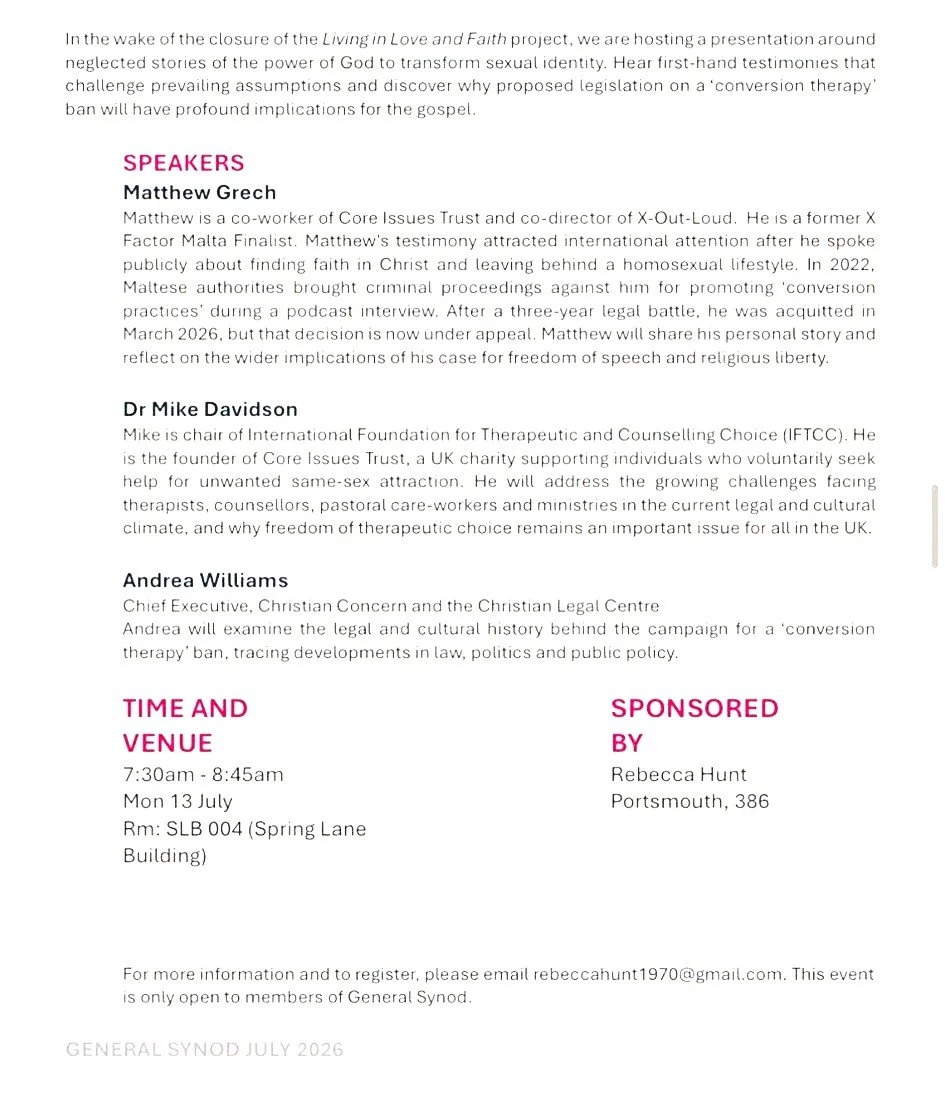
Fringe event - People Change: Sexual Identity Transformation
The fringe event, People Change: Sexual Identity Transformation proposes to present “neglected stories of the power of God to transform sexual identity”. One of the speakers at the event, Matthew Grech, has spoken about how his faith in Jesus helped him leave behind a homosexual lifestyle. A second speaker, Dr Mike Davidson is founder of Core Issues Trust, a charity supporting people seeking help for “unwanted same-sex attraction”. The third speaker, Andrea Williams, the Chief Executive of Christian Concern and the Christian Legal Centre and is well known to me from past encounters at General Synod. She is a fundamentalist Christian who campaigns for the freedom to use the legal system to provide religious exemptions to laws on equality. She has waged a relentless campaign against all aspects of tolerance and equality for LGBTQIA+ people.
The event is on Monday 13 July from 07.30 to 08 45 and is only open to members of General Synod. “Sexual Identity Transformation” is a phrase that can be used to describe the deeply personal journey that can involve self-discovery through exploring feelings and experiences related to gender identity, coming out by sharing one’s gender identity with others, social transition by changing one’s public gender expression and medical transition which can involve HRT and gender-affirming surgery. Such a process of transitioning is recommended for people experiencing gender dysphoria. The process advocated by Core Issues Trust, Christian Concern and the Christian Legal Centre is in fact conversion therapy, the exact opposite of the sexual identity transformation being advocated by the Synod event and exhibition.
The following letter from eighty-two Synod members to the Archbishops explains why the exhibition stand in particular is so objectionable and contrary to the church’s safeguarding guidance.
Letter to the Archbishops of Canterbury and York
Robert Thompson, Vicar of St Mary with All Souls Kilburn and St James’ West Hampstead
Sunday 28th June 2026
Dear Sarah and Stephen,
People Change: Sexual Identity Transformation – Request for the Exercise of the Presidents' Discretionary Powers under the Fringe Meeting Guidelines
We write as members of the General Synod regarding the approval of the fringe event People Change: Sexual Identity Transformation and the allocation of exhibition space to the same organisation during the forthcoming group of sessions.
At the outset, we wish to be clear about what this letter is, and is not, seeking to do.
We recognise and value the role of the Synod fringe in enabling members to explore difficult questions that may not readily find space within formal debates. A healthy fringe programme contributes to the breadth of Synod’s common life, and we fully accept that it should include a wide range of theological perspectives, including differing convictions on sexuality, marriage and pastoral practice. We are therefore not asking you to adjudicate the theology of this event, nor to restrict legitimate theological debate.
Rather, we are seeking to understand how the decisions to approve both the fringe event and the associated exhibition stand were reached in the light of the Church of England’s safeguarding commitments, the published Fringe Meeting Guidelines, and the vision of General Synod as a body called to “walk together” despite profound disagreement.
Throughout this quinquennium, both of you have consistently encouraged members of General Synod to walk together. We have welcomed that vision. It calls us to remain in relationship with one another, to listen generously and to recognise one another as sibling members of the Body of Christ seeking faithfully to discern God’s will. It seems to us that there is an important distinction between creating space to debate what Christians believe and creating space to debate whether sibling members of Synod should be different people from those whom God has created and called them to be.
For many LGBTQIA+ members of Synod, this is not an abstract theological question. We do not regard our sexual orientation as a defect awaiting transformation. Rather, we believe it is part of the person God has created and called. It has shaped our discipleship, enriched our ministry and, for many of us, deepened our solidarity with others who have experienced exclusion, prejudice and marginalisation. It is therefore difficult to understand why the Church of England should provide not only a fringe platform, but also a continuing presence within the shared public spaces of General Synod, for an organisation whose title appears to place the identity of some sibling members of Synod under scrutiny.
A fringe meeting is an event that members may choose whether or not to attend. An exhibition stand is different. It forms part of the shared environment of Synod and is encountered repeatedly by members throughout the group of sessions. We would therefore be grateful to understand whether different considerations applied to the allocation of exhibition space and, in particular, how the impact upon LGBTQIA+ members of Synod was assessed.
The Fringe Meeting Guidelines expressly reserve to you, as Presidents of the General Synod, the right to refuse a fringe meeting where its subject matter would be contrary to the ethos of the Church of England, may adversely affect its reputation, or would be inconsistent with House of Bishops’ safeguarding guidance. We would therefore be grateful if you could explain how those criteria were applied in relation to both the fringe meeting and the exhibition stand.
Our concern is heightened by the Church’s own safeguarding commitments.
General Synod has previously endorsed the Memorandum of Understanding on Conversion Therapy, recognising the harms associated with conversion practices and supporting legislative action to prohibit them. The House of Bishops’ safeguarding guidance has likewise made clear that ministry should never seek to change or influence a person’s sexual orientation through deliverance ministry or comparable pastoral practice. The recent publication of the Government’s Draft Conversion Practices Bill has further focused public attention on these issues. Whatever differing views may be held about aspects of that legislation, we believe it makes it all the more important that the Church of England is able to explain clearly how decisions of this nature are reached and how they are reconciled with its own safeguarding commitments. We would therefore be grateful to know whether safeguarding assessments were undertaken in relation to both the fringe event and the exhibition stand and, if so, whether they specifically considered the potential psychological and spiritual impact upon LGBTQIA+ members of Synod.
Finally, we believe this experience raises a wider question of governance. The published guidance confers a significant discretion upon the Presidents in determining whether proposed fringe events are compatible with the Church’s safeguarding guidance and the ethos of the Church of England. We would welcome greater transparency regarding the principles by which that discretion is exercised, not simply in relation to this event but for all future fringe meetings and exhibition stands. We therefore respectfully ask:
1. How were the fringe event and exhibition stand assessed against the Church’s published criteria?
2. Were safeguarding assessments undertaken and, if so, what considerations informed those assessments?
3. How was the impact upon LGBTQIA+ members of Synod considered during those processes?
4. What understanding did the approving authority have of the phrase “sexual identity transformation” when considering these applications?
5. How do these decisions sit alongside the Church’s safeguarding commitments concerning conversion practices?
6. Will the Presidents publish the principles by which future fringe meetings and exhibition stands are assessed?
We offer these questions respectfully and in good faith. Our purpose is not to curtail theological debate, but to understand how the Church’s commitments to safeguarding, transparency, mutual flourishing and walking together have been applied in this instance. We hope your response will reassure all members of General Synod that our shared life remains one in which every sibling member is able to participate with equal dignity, belonging and confidence.
For transparency, I have copied this correspondence to those with responsibilities for the governance of General Synod, safeguarding, the bishops in the Diocese of London in whose ministry I share, and those with interest in the Church’s relationship with Parliament and government.
Yours sincerely,
Robert Thompson London 166
On behalf of:
No. Name Diocese / Constituency
055 Mandy Ford Bristol
071 Kat Campion-Spall Bristol
072 Alice Kemp Bristol
073 Adam Beaumont Bristol
076 Rachel Webbley Canterbury
083 Jane Richards Chelmsford
085 Brenda Wallace Chelmsford
088 Jenny Bridgman Chester
090 Clair Jaquiss Chester
096 Jules Middleton Chichester
097 Martin Poole Chichester
098 Claire McArthur Coventry
103 Julian Hollywell Derby
104 David Tolhurst Durham
105 Lesley Jones Durham
108 Chantal Noppen Durham
116 Rosie Austin Exeter
122 Simon Talbot Ely
125 Barnaby Perkins Guildford
127 Jo Winn-Smith Guildford
132 Robb Sutherland Leeds
136 Joyce Jones Leeds
137 Catherine Shelley Leeds
142 Clive Watts Leicester
144 Abbie Walsh Lichfield
150 Stuart Cradduck Lincoln
155 Martin Thorpe Liverpool
156 Miranda Threlfall-Holmes Liverpool
165 Jody Stowell London
166 Robert Thompson London
171 Rachel Mann Manchester
178 Claire Robson Newcastle
181 Graham Kirk-Spriggs Norwich
201 Trudi Oliver Rochester
206 Rachel Wakefield St Albans
208 Andrew Dotchin St Edmundsbury & Ipswich
221 Charlie Bell Southwark
241 Liz Hassall York
249 Nic Tall Bath & Wells
252 Rachel Jepson Birmingham
254 Paul Hannah Blackburn
257 Paul Ronson Blackburn
258 Jacqueline Stamper Blackburn
263 David Kemp Canterbury
269 Gill Ball Chelmsford
271 Kat D'Arcy-Cumber Chelmsford
277 Janette Allotey Chester
279 Alan Dowen Chester
282 Sam Wilson Chester
285 Martin Auton-Lloyd Chichester
290 Tina Nay Chichester
294 Gill Frigerio Coventry
303 Felicity Cooke Ely
306 Ludovic Claude Europe
312 Vivien Southall Exeter
321 Wendy Coombey Hereford
322 Emily Hill Hereford
325 Judith Osborne Leeds
326 Jane Evans Leeds
331 Diana Treymane Leeds
344 Muriel Robinson Lincoln
347 Nadine Daniel Liverpool
351 Philip Baldwin London
357 Fiona MacMillan London
361 Robert Zampetti London
364 Abigail Ogier Manchester
366 James Wilson Manchester
368 Nicola Denyer Newcastle
369 Izzy McDonald-Booth Newcastle
373 Peter Barrett Oxford
378 Helen King Oxford
382 Vicky Brett Peterborough
389 Jane Rosam Rochester
393 Sheila Bissell St Albans
396 Becky Mynett St Albans
407 Ruth Abernethy Channel Islands (Guernsey)
410 Robin Hall Europe
436 Lucy Gorman York
439 Sammi Tooze York
452 Judith Maltby Universities & TEIs
461 James Ridge Ex Officio
497 Joel Plant Co-opted Young Adult (Leicester)